Ceiling Fan Not Working in Santa Fe, NM? Here Is How to Diagnose, Repair, and Replace One
September 8, 2026

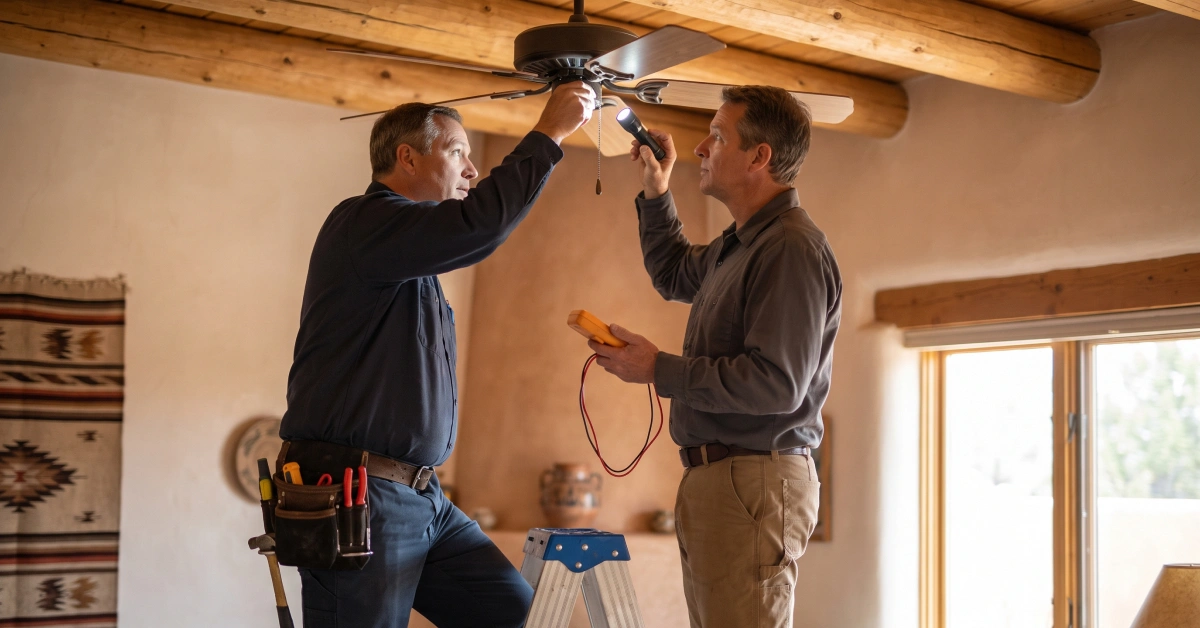
A ceiling fan that stops working in a Santa Fe summer is more than an inconvenience. In a city where many homes rely on fans rather than central air conditioning to stay comfortable through June, July, and August, a non functioning fan can make a room genuinely unpleasant. Repairing and installation ceiling fan work comes up regularly for Santa Fe homeowners, and the right approach depends entirely on what went wrong and how old the fixture is. This guide walks you through the common causes, what you can check yourself, and when the job calls for a professional.
| Quick AnswerA ceiling fan that stops working in Santa Fe usually has one of four causes: a failed capacitor, a wiring problem at the switch or junction box, loose internal connections, or a motor that has reached the end of its service life. Most capacitor and wiring faults are repairable. A seized or burnt motor typically means replacement is the more practical choice. |
Santa Fe sits at over 7,000 feet elevation, which moderates the summer heat compared to lower desert cities. But with a fan not working in peak summer, even a high altitude home gets uncomfortable quickly. But the Railyard District, the Agua Fria neighborhood, and the residential streets of the Eastside all see temperatures in the 90s regularly from late May through August. In homes without central air conditioning, and many historic Santa Fe properties do not have it or have window units only, a ceiling fan is often the primary source of cool air circulation. When it stops working, there is usually a specific reason.
| Symptom | Likely Cause | Repair or Replace? |
| Fan spins slowly | Worn capacitor or motor | Usually repair |
| Fan wobbles or shakes | Unbalanced blades or loose screws | Repair |
| Fan hums but does not spin | Seized motor or failed capacitor | Repair or replace |
| Fan works but has no light | Failed bulb, socket, or wiring | Repair |
| Fan sparks or smells burnt | Electrical fault or failing motor | Replace immediately |
| Fan is completely dead | Wiring, switch, or motor failure | Diagnose first |
The capacitor is a small electrical component inside the fan housing that starts the motor and regulates its speed. When it fails, the fan may hum but not spin, spin only on one speed, or spin very slowly regardless of the speed setting. This is one of the most common faults in fans that are five to ten years old. A slow fan that once moved air properly but now barely turns is a classic capacitor symptom. Replacing a capacitor is a repair job, not a replacement job, but it does involve opening the fan housing and working near electrical components.
A fan that wobbles, shakes, or makes a rhythmic clicking sound during operation usually has a mechanical rather than electrical cause. Blade imbalance, bracket bend, and fasteners that have worked loose all produce this behavior. In older Santa Fe homes with vigas and latilla ceilings, fans are sometimes mounted on angled surfaces or with adapters that can shift over time, which affects how the blades sit. A wobbling fan is more than annoying. The vibration works fasteners loose further over time and can eventually compromise the junction box mounting.
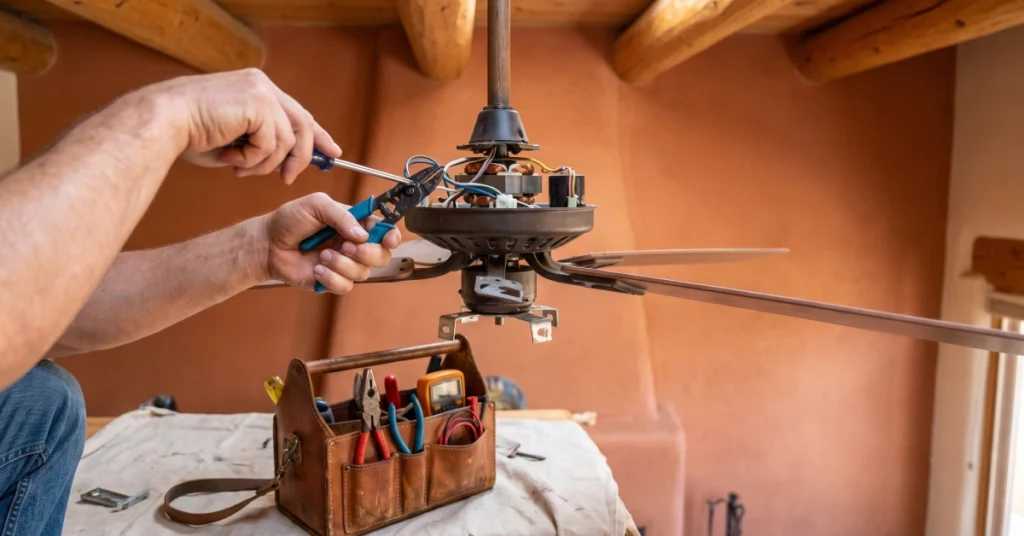
Wiring issues are less common than mechanical or capacitor failures but more significant when they occur. A fan that is completely dead with no response from any switch position may have a wiring fault at the wall switch, at the remote receiver inside the housing, or at the junction box connection itself. Older Santa Fe homes, particularly in the Eastside and Agua Fria neighborhoods where housing stock includes properties from the mid-twentieth century, sometimes have wiring conditions that do not match the requirements of modern fan installations. Aluminum wiring, undersized junction boxes, and missing neutral conductors at switch locations are conditions we encounter in this city’s older properties.
This is often overlooked. Blade dust accumulation builds a thick layer on the upper surface, which changes the weight distribution and reduces the amount of air the fan moves. A fan that seems sluggish or that produces less airflow than it used to may simply need its blades cleaned. This is worth checking before assuming a mechanical fault. The dust layer in Santa Fe homes can be significant, particularly on properties near Midtown Santa Fe Park and other areas with mature trees that produce pollen and fine particulate through the spring months.
Ceiling fans look straightforward to install and repair. You are replacing something that is already there, the wiring is already run, and the videos online make it look like an hour of work. For a new home with modern electrical infrastructure, that can be true. For a Santa Fe home with adobe construction, older wiring, or a junction box that was not installed for a fan load, the variables multiply quickly.
A standard electrical box in the ceiling is not rated for the dynamic load of a ceiling fan. Fans produce vibration and torque that a light fixture box cannot handle safely. If a previous homeowner installed a fan on a standard box, or if you are adding a fan where only a light existed, the box needs to be upgraded to a fan rated or fan brace box before the installation proceeds. Installing a fan on the wrong box is a safety issue that shows up weeks or months later when the box loosens and the fan drops.
Santa Fe’s historic homes often have high ceilings with vigas, which places a fan installation at an awkward working height. Working on a ladder with live electrical components overhead requires care. Shutting off the correct circuit breaker, confirming the circuit is de-energized with a non-contact voltage tester, and having a stable platform are all steps that must be completed before touching anything. Skipping any of them turns a manageable job into an injury risk.
Modern fans that include a remote receiver or require separate switches for the fan motor and light kit involve wiring that goes beyond the basic two-wire connection of an old light fixture. If the switch location only has a single switch leg, adding a separate fan speed control and light dimmer requires either running a new wire or using a wireless remote system. Getting this wrong produces fans that run continuously, lights that flicker, or switches that do not control what they should. Identifying what wiring is available at the switch location before specifying the installation method is the step that prevents these outcomes.
| PRO TIP: Before calling anyone about a ceiling fan that has stopped working, try this first check whether the circuit breaker for that room has tripped. Then locate the small reset button on the underside of the motor housing, which is present on many fan models and sometimes trips independently of the breaker. If the fan has a remote control, replace the batteries in both the remote and the receiver before assuming the fan itself has failed. These three checks resolve a surprising number of service calls and take less than five minutes. |
Home Repairs Made Easy Inc approaches ceiling fan work the same way we approach any repair in Santa Fe home: diagnose accurately before recommending anything. Our recommendation comes from what we actually find, not from a default toward the more expensive option.
We start with the circuit, confirm the breaker is on and the outlet or switch is live, and then test the fan’s response. We check for the basic mechanical issues first, loose blade screws, balance, mounting security, and blade condition. Then we open the housing and inspect the capacitor, internal wiring connections, and receiver if the fan has one. This sequence avoids unnecessary disassembly and tells us what we are actually dealing with.
Once the fault is identified, we give a straightforward assessment of what the repair costs versus what a new energy efficient fan of similar quality would cost installed. If the fan is relatively new and the fault is a replaceable component, fixing it makes clear sense. If the fan is aging, the motor is seized or burnt, or the parts are no longer available, a new fixture is the more practical path. We tell you which situation you are in and let you decide.
For repairs, we source the correct replacement component, make the repair with the circuit confirmed off, and test through all speed settings and the light kit before completing the job. For installations, we verify the junction box rating, upgrade it if necessary, run the wiring connection correctly for the switch configuration at that location, mount the fan, attach and balance the blades, and test the complete installation. We do not leave until the fan runs on all speeds without wobble and the light operates correctly on its switch.
A freshly installed fan that is slightly out of balance will develop a wobble that worsens over time as the vibration works fasteners loose. We check blade balance after installation and use balancing clips where needed to bring the fan into smooth operation. This step takes an extra few minutes and prevents a callback weeks later.
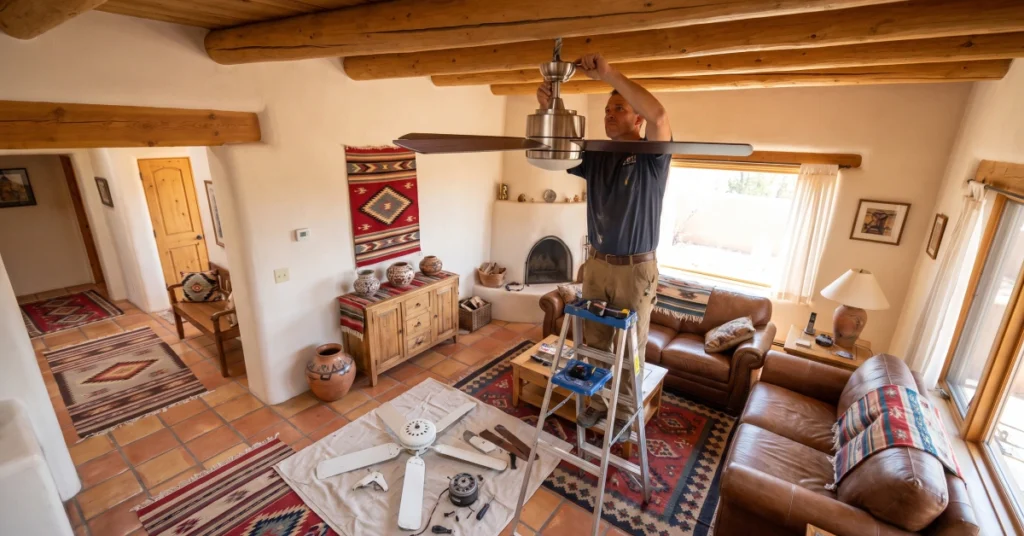
| Need Ceiling Fan Repair or Installation in Santa Fe? Call Home Repairs Made Easy Inc at (505) 397-7125. Serving the Railyard District, Agua Fria, Eastside, and all of Santa Fe. |
How much does ceiling fan repair cost in Santa Fe?
Most ceiling fan repairs in Santa Fe run between the cost of a service call and two to three times that depending on the parts required. A capacitor replacement is one of the less expensive repairs. Wiring work at the switch or junction box costs more depending on the complexity. We give you a clear estimate after diagnosing the fault so you can compare the repair cost against replacement before deciding.
Is it worth repairing an older ceiling fan or should I just replace it?
It depends on the age of the fan, the cost of the part, and how long the fan is likely to run afterward. A five year old fan with a failed capacitor is worth repairing. A fifteen year old fan with a seized motor in a home near the Museum of International Folk Art where the rooms have high viga ceilings and a good replacement would take the same installation effort is usually better replaced. We walk you through both options with real numbers when we diagnose.
Can I install a ceiling fan myself in my Santa Fe adobe home?
If the existing junction box is fan rated, the wiring is straightforward, and you are comfortable working on a ladder with electrical components after confirming the circuit is off, a basic swap of one fan for another is manageable for a confident DIYer. Where it gets complicated in Santa Fe specifically is older wiring configurations, high ceiling heights on historic properties, and junction boxes that were never intended for fan loads. If any of those apply, a professional handyman is the right call.
Why does my ceiling fan in my Agua Fria neighborhood home wobble?
Wobbling in ceiling fans is almost always caused by blade imbalance, loose fasteners at the blade brackets, or a blade that has warped slightly. In Agua Fria and other older Santa Fe neighborhoods, ceiling mounting surfaces are sometimes not perfectly level, which adds to the challenge. We check blade balance, bracket tightness, and mounting levelness as part of any wobble diagnosis. Most wobble issues are correctable without replacement.
Do I need a special ceiling fan for Santa Fe’s high-altitude climate?
Not specifically, though fan efficiency at higher altitude is slightly different because the air is less dense. Fans move less air per revolution at 7,000 feet than at sea level. This means selecting a fan with an appropriately sized blade span for the room is more important here than in lower altitude cities. A fan that is too small for the room will underperform noticeably at Santa Fe’s elevation. We account for room size and ceiling height when recommending a replacement fan.
How long should a ceiling fan last in a Santa Fe home?
A quality ceiling fan installed correctly typically lasts 10 to 15 years with normal use. In Santa Fe’s environment, dust accumulation on blades and bearings is the primary maintenance factor. Keeping blades clean, ensuring screws are checked periodically, and not running the fan on a loose or improperly rated junction box all contribute to reaching the full service life. Fans that are run continuously through the summer months in homes without AC will wear faster than those used intermittently.
In a city where summer comfort often depends on moving air rather than refrigerated air, a ceiling fan that fails in late June is a real problem for Santa Fe homeowners in the Railyard District, Agua Fria, the Eastside, and across the city. Most ceiling fan problems have a fixable cause, and a proper diagnosis before committing to repair or replacement saves both time and money.
Whether the issue is a slow fan from a worn capacitor, a wobble from blade imbalance or fasteners that have worked loose over time, a wiring problem at an older switch location, or a complete installation in an adobe home with a high viga ceiling, repairing and installation of a ceiling fan is work that benefits from a professional who understands Santa Fe’s specific housing stock and electrical conditions.


 Serving Santa Fe, NM and Surrounding Cities
